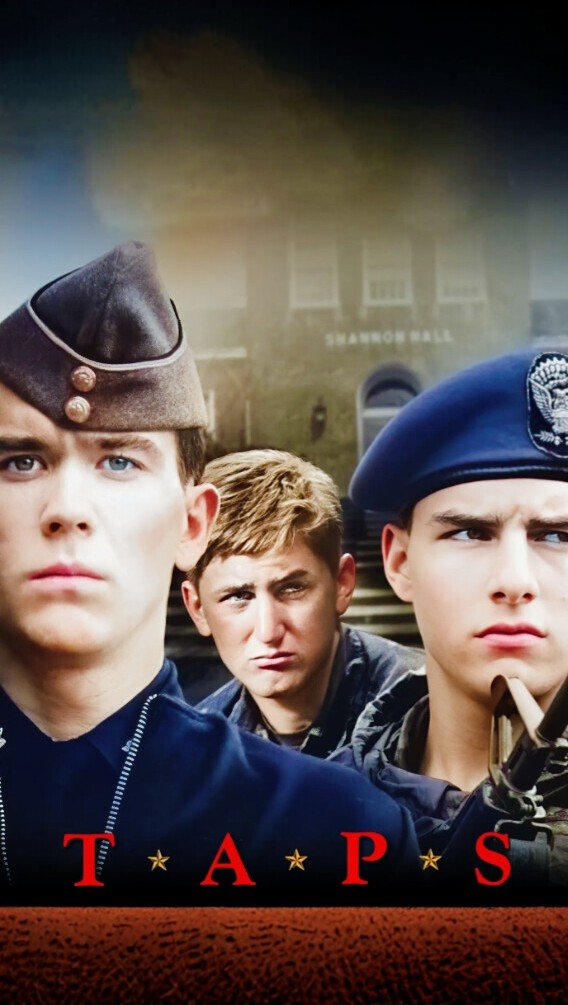
TAPS offers a powerful examination of ideals versus reality, showcasing the psychological impact of military life on youth.
Uncover the layers of Taps, where obedience and ambition lead to a tragic descent into madness within a military academy.
INTRODUCTION: WHY TAPS STILL HAUNTS US IN 2026
“Obedience is the cement that holds an army together.” – General Alexander Bache (George C. Scott), TAPS (1981)
Let that quote linger for a second.
Now imagine a group of teenage boys swallowing that ideology whole — until it becomes their only religion. That’s the nuclear core of TAPS, the 1981 psychological war drama that masquerades as a coming-of-age military movie but is, in truth, a slow-burning, emotionally devastating descent into madness and moral collapse.
Set in the stiff, marble corridors of Bunker Hill Military Academy, TAPS isn’t just a story. It’s a character autopsy. A real-time dissection of youth, leadership, obedience, and moral ambiguity — all dressed in spotless cadet uniforms and loaded rifles. What starts as idealism ends in a bloodbath, and the real weapon isn’t the gun — it’s psychology.
So why are we talking about this in 2026? Because TAPS isn’t dated. It’s timeless. It’s savage. It’s a psychological war cry against blind obedience and a society that grooms young men for martyrdom before they even find themselves. Let’s rip this open and dive into the raw, pulsating nerve endings of this cinematic tragedy.
THE PREMISE OF TAPS: A TRAGEDY DISGUISED AS DUTY
The story kicks off with a prestigious military academy facing closure.
General Bache, a revered father figure to the cadets, suffers a heart attack after a scuffle during a dance event that turns deadly. In response, Cadet Major Brian Moreland (played chillingly by a young Timothy Hutton) rallies his fellow cadets into taking over the academy to prevent its shutdown.
What starts as a defensive stance morphs into a militarized siege, complete with armed teenagers, moral blind spots, and psychological implosions.
Let’s be clear — TAPS isn’t about heroism. It’s about obsession. It’s about what happens when adolescents are handed ideology without the tools to question it. When idealism turns into a fortress, every disagreement becomes a war zone.
There’s no true enemy in TAPS — only choices. And the most terrifying part? Every single tragic decision is psychologically justifiable. Every action is an echo of real-world psychological theories. That’s what makes it brutal. That’s what makes it real.
AUTHORITY VS. AUTONOMY : A DANGEROUS GAME
Let’s talk about obedience.
Psychological obedience, to be exact. The kind that runs deeper than military protocol — the kind that rewires a person’s sense of self.
Stanley Milgram’s infamous obedience study in the 1960s showed us just how far ordinary people would go when instructed by an authority figure.
Over 65% of participants administered what they believed were lethal electric shocks simply because someone in a lab coat told them to. TAPS takes that idea and cranks the volume up to 11.
Moreland becomes the de facto authority figure, not by force, but by reverence. He’s young. He’s disciplined. He speaks like Bache. He moves like Bache. He is Bache — in the eyes of his peers. And just like that, the lines blur between loyalty and loss of self.
Psychological Term: Authoritarian Conditioning
A process by which individuals learn to obey authority without question, especially when it has been reinforced by positive role models or institutions.
In TAPS, autonomy — the ability to think independently — is sacrificed at the altar of honor. And when autonomy dies, morality follows.
THE CULT OF LEADERSHIP: GENERAL BACHE AND CADET MAJOR MORELAND
General Bache is not just a commander.
He’s a deity in the minds of these boys. Especially for Moreland. The psychological mechanism at play here is called transference — the projection of parental or emotional roles onto authority figures.
When Bache collapses, Moreland doesn’t just lose a mentor. He loses a father figure. The grief isn’t processed emotionally; it’s transformed into a militant mission. Moreland inherits Bache’s dream and carries it like a cross — dragging everyone else along.
Quote from the film:
“He believed in us. He gave us something. I won’t let them take it away.”
This isn’t leadership. It’s canonization. And when leaders become saints in the minds of their followers, there’s no room left for accountability.
GROUPTHINK IN UNIFORM: THE ECHO CHAMBER OF CONTROL
Ever heard of groupthink?
It’s the psychological phenomenon where a group of people, in the pursuit of harmony or conformity, make irrational or dysfunctional decisions — often suppressing dissenting opinions to preserve the illusion of unity.
TAPS bleeds groupthink from every frame. Once Moreland makes the call, the rest follow — even if they feel uneasy. They rationalize, justify, and emotionally blackmail each other into compliance. There’s no space for doubt. Dissent equals betrayal.
Psychological Definition:
Groupthink occurs when the desire for group cohesion overrides realistic appraisal of alternatives.
Classic example? The Challenger Space Shuttle disaster. Engineers had doubts. But group cohesion was prioritized. The result? Catastrophe. Just like TAPS.
And here’s the kicker — these boys weren’t evil. They were scared. Trapped in an ideology that punished hesitation and rewarded loyalty. And that’s how groupthink becomes lethal.