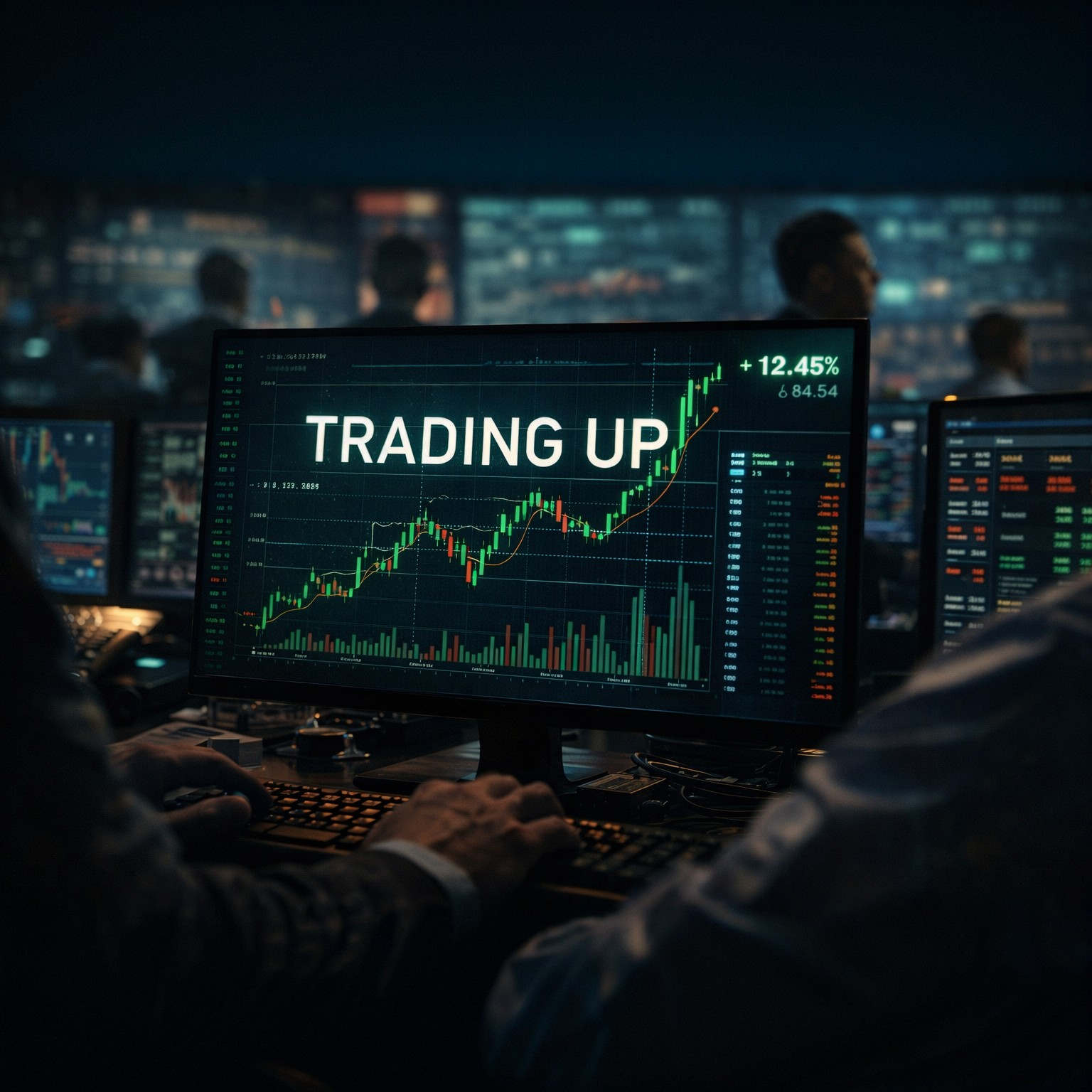
Learn what Trading Up means and how price movements indicate market demand overpowering supply in trading.
TRADING UP is not optimism.
- It is not hope.
- It is not narrative.
TRADING UP is the market repricing reality under pressure.
- Price moves first.
- Explanations follow later.
That gap between the two is where money is made — or destroyed.
WHAT IS TRADING UP — THE TECHNICAL TRUTH
TRADING UP means a security is trading above a key reference point.
That reference point is usually:
- The previous day’s close
- The session open
- A recent consolidation range
According to Investopedia:
“When a stock is trading up, it means the price has increased from its previous closing price due to increased buying interest.”
No emotion.
No theory.
Just demand overpowering supply.
THE STAT THAT MATTERS: VOLUME
Price without volume is theater.
Price with volume is intent.
According to Nasdaq market research, over 70% of sustainable price advances are accompanied by above-average volume during the move.
That’s why professionals don’t ask:
“Is it trading up?”
They ask:
“Who is buying — and how aggressively?”
WHY TRADING UP HAPPENS
TRADING UP is triggered by force, not vibes.
Common catalysts:
- Earnings beats or raised guidance
- Analyst upgrades
- Macro shocks (rates, inflation, policy)
- Short interest pressure
- Algorithmic momentum ignition
Once triggered, volume decides survival.
Without it, the move dies.
With it, the move spreads.
CASE STUDY: EARNINGS-DRIVEN TRADING UP
Case: Nvidia earnings reactions (2023–2024)
Following multiple earnings beats, Nvidia shares repeatedly opened flat and then began TRADING UP aggressively during the session, not just at the open.
What mattered:
- Volume surged well above 30-day averages
- Price held gains into the close
- Follow-through buying occurred the next session
This is textbook institutional TRADING UP.
Funds weren’t chasing headlines.
They were repositioning portfolios in real time.
TRADING UP VS GAP UP (THE MISREAD)
A gap up happens at the open.
TRADING UP can happen anytime.
According to CME market education data, nearly 60% of gap-up openings partially retrace within the same session.
That’s why professionals wait.
If a stock gaps up but fails to continue TRADING UP, the move was noise.
Continuation matters.
Follow-through matters.
CASE STUDY: FALSE TRADING UP
Case: Meme-stock squeezes
During the 2021–2024 meme-stock cycles, many stocks were TRADING UP sharply — but on collapsing fundamentals.
Academic research from the Journal of Finance found that stocks driven primarily by retail momentum without earnings support underperformed the market by over 20% within six months.
Price rose fast.
Conviction vanished faster.
That’s TRADING UP without foundation.
WHEN TRADING UP IS REAL
Real TRADING UP shows signs professionals respect:
- Expanding volume
- Strength while the broader market is weak
- Minimal pullbacks
- Institutional-sized order flow
As hedge fund manager Paul Tudor Jones famously said:
“Price is the ultimate truth.”
But volume tells you who believes it.
WHY HEDGE FUNDS STUDY TRADING UP
Funds don’t chase green candles.
They read pressure.
TRADING UP reveals:
- Short positioning stress
- Late institutional entry
- Narrative shifts before consensus
It is early evidence, not confirmation.
That’s why it’s watched — not worshiped.
THE VIOLENCE INSIDE TRADING UP
Markets are not polite systems.
They are elimination engines.
Every TRADING UP move:
- Forces shorts to cover
- Forces longs to commit
- Forces hesitation to pay
There is no neutral outcome.
Someone absorbs the loss.
Someone claims the ground.
THE BOTTOM LINE
TRADING UP is not bullish by default.
It is informational warfare.
It tells you:
- Demand is asserting dominance
- Pressure is shifting
- A new reality may be forming
Ignore it, and you get blindsided.
Chase it blindly, and you get punished.
Understand TRADING UP,
and you learn how markets speak before they scream.