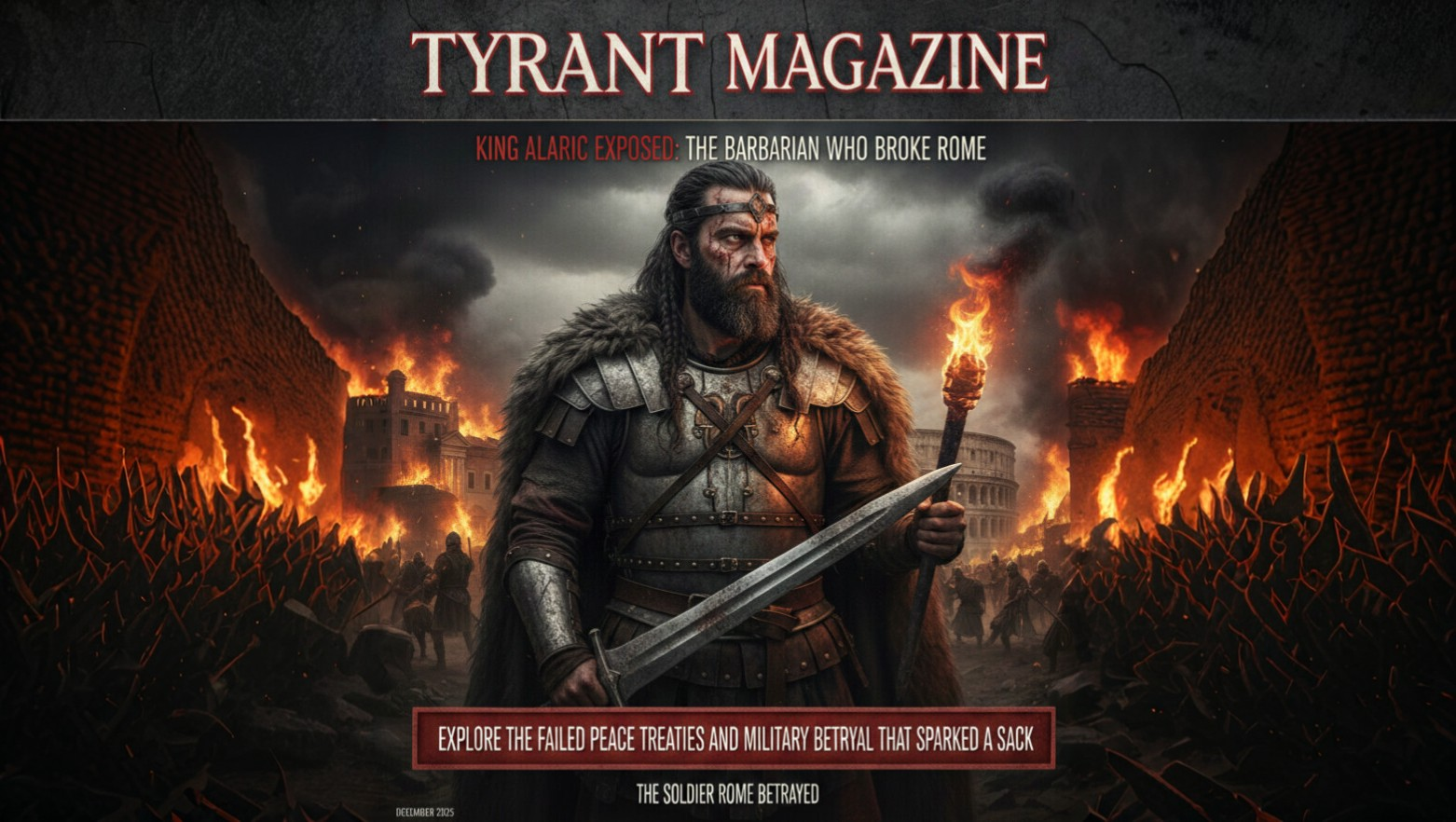
KING ALARIC EXPOSED! Discover the brutal truth behind the man who broke Rome. Explore his failed peace treaties and the military betrayal that sparked a sack.
History favors the “civilized,” but the ruins of Rome tell a different story. King Alaric didn’t just appear at the gates with a torch; he was a monster the Empire spent decades creating. Before the fires of 410 AD, there were years of broken promises, military betrayals, and the lethal ego of Roman leadership.
The “barbarian” was, in fact, Rome’s most loyal soldier—until they gave him no choice but to burn it all down. The man who once fought under Roman command turned their own tactics against them, using insider knowledge of their politics, supply lines, and defenses to corner an empire that thought it could never fall.
Explore the failed peace treaties and the systemic backstabbing that left the Eternal City defenseless against the man who knew all their secrets.
KING ALARIC AT A GLANCE: THE ANATOMY OF THE DOWNFALL OF ROME
- ALARIC’S MOTIVE
- The Roman Myth: A mindless barbarian raid.
- The Brutal Reality: A desperate fight for food, land, and survival for his people.
- THE DIPLOMACY
- The Roman Myth: Rome tried to save the city.
- The Brutal Reality: Rome ignored or sabotaged multiple peace offers that asked for grain, land, and formal status—not conquest.
- THE MILITARY
- The Roman Myth: Alaric was an outsider.
- The Brutal Reality: Alaric was once a high-ranking Roman commander of Gothic troops who had fought for imperial victories before turning against the Empire.
- THE AFTERMATH
- The Roman Myth: Total destruction of culture.
- The Brutal Reality: A calculated strike that shook the elite and exposed Rome’s weakness more than it erased its world.
KING ALARIC: THE SOLDIER ROME BETRAYED
Alaric wasn’t a stranger to the Roman walls; he was a product of their military machine, raised in a world where Gothic warriors bled for Roman glory in exchange for land and pay that rarely arrived on time. He fought for the emperor, marched in Roman campaigns, and expected the one thing Rome was too arrogant to give: respect.
When imperial politics turned, the same Empire that used Gothic bodies as shields began treating them as disposable. After the death of the powerful general Stilicho, Roman hardliners whipped up anti-“barbarian” hysteria, and Gothic families—wives, children, and allies—were slaughtered inside Roman territory.
In that moment, Alaric’s loyalty died, and something far more dangerous took its place.
THE PEACE THAT NEVER WAS
Before the final sack, Alaric didn’t storm in demanding blood—he came asking for terms. He didn’t want the ashes of Rome; he wanted a future for his people. He asked for:
- Land in the provinces where his followers could legally settle.
- Grain shipments to feed a population Rome had already starved through policy and war.
- A military title and recognition that matched his years of service and battlefield victories under Roman command.
Each time, the Roman elite—comfortable and insulated behind the marshes and walls of Ravenna—shrugged. They stalled negotiations, played factions against each other, and assumed the “barbarian” outside their gates needed them more than they needed him. They chose pride over survival. They were wrong.
THE BREAKING POINT: 410 AD
When Roman leaders allowed or encouraged the massacre of Gothic families within the Empire’s borders, they didn’t just tighten security—they signed Rome’s death warrant. Alaric stopped asking for peace and started hunting justice.
On August 24, 410 AD, the unthinkable became reality: Rome’s defenses finally cracked. Through the Salarian Gate, Alaric’s forces slipped into the city, aided by insiders who opened the way under cover of darkness and chaos. For the first time in nearly 800 years, a foreign enemy stormed into Rome.
For three relentless days, Visigoth warriors flooded the streets, looting the wealth of an empire that had refused to pay its debts in anything but blood. Yet even in the chaos, this was not the cartoonish barbarian rampage Rome later liked to remember.
Churches and many civilians were spared, while symbols of imperial luxury, power, and privilege took the hardest hits.
The sack of Rome in 410 AD was more than a military victory; it was an x-ray of imperial rot. The city that once bragged about ruling the world was stripped bare by a man it had trained, used, and discarded. In three days, King Alaric showed the world that the Eternal City was only human—and very, very breakable.
“He who is not given a seat at the table will eventually burn the house down to keep warm.” — M.
King Alaric didn’t just break Rome. He made sure the whole world watched it fall.