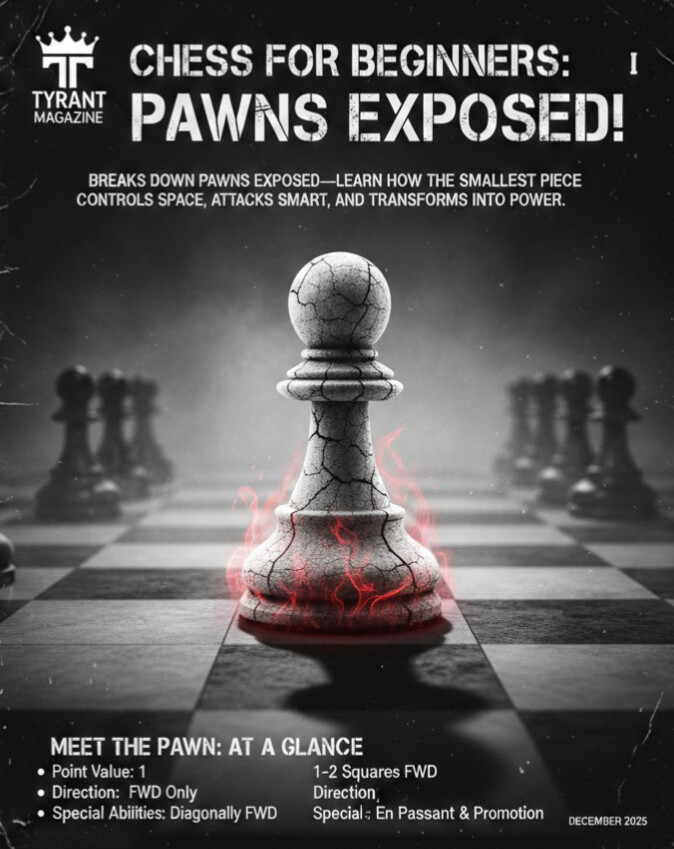
CHESS FOR BEGINNERS BREAKS DOWN PAWNS EXPOSED—LEARN HOW THE SMALLEST PIECE CONTROLS SPACE, ATTACKS SMART, AND TRANSFORMS INTO POWER.
In Tyrant Magazine, “Chess for Beginners” unveils the hidden might of the humble pawn. These tiny titans are not just foot soldiers—they’re the secret rulers of the board! Discover how these underestimated pieces control vast territories, launch cunning attacks, and, in a jaw-dropping twist, transform into game-changing queens.
Don’t miss out on mastering the art of pawn power and turning the tables on your opponents. Get ready to dominate the board with the ultimate underdog strategy.
MEET THE PAWN: AT A GLANCE (CHESS FOR BEGINNERS)
For those new to chess, here is a concise explanation of the pawn’s movements and functions.
- Point Value: Worth 1 point (the baseline for all chess pieces).
- Movement: Moves 1 square forward (can move 2 squares on its very first move).
- Direction: Can only move forward; the Pawn never moves backward.
- Capturing: Attacks and captures exactly 1 square diagonally forward.
- Special Abilities: Capable of En Passant captures and Promotion to a stronger piece.
THE SMALLEST PIECE RUNNING THE WHOLE SHOW
In CHESS FOR BEGINNERS, the pawn is the first piece you must understand.
It looks small.
But it quietly runs the board.
If you ignore your pawns, your position falls apart fast.
Control them, and the game becomes clear.
Here is the basic breakdown.
WHAT IS A PAWN? THE ENTRY-LEVEL PIECE WITH REAL POWER
A pawn is the smallest piece on the chessboard.
Each player starts with eight pawns.
They stand in a straight line in front of the stronger pieces.
They take the first hit.
They launch the first push forward.
Each pawn is worth one point.
That is the lowest value in chess.
But low value does not mean low impact.
Pawns shape the entire battle.
HOW DOES A PAWN MOVE? NO REVERSE. JUST FORWARD (CHESS FOR BEGINNERS)
A pawn moves forward only.
It never moves backward.
Every move is permanent.
Most of the time, it moves one square.
On its first move, it may go two squares forward.
Pawns do not capture straight ahead.
They capture one square diagonally.
If a piece blocks the square in front, the pawn cannot move.
It must wait.
Simple rules.
Serious consequences.
SPECIAL RULE: EN PASSANT
There is one special capture called en passant.
If an enemy pawn jumps two squares and lands beside yours, you may capture it as if it moved only one square.
But you must act immediately.
Wait one turn and the chance is gone.
Timing matters in chess.
WHAT IS PROMOTION? FROM PAWN TO POWER
If a pawn reaches the other side of the board, it promotes.
It can turn into a queen, rook, bishop, or knight.
Most players choose a queen.
A pawn cannot become a king.
But it must transform.
The smallest piece can become the strongest.
That is the hidden drama of chess.
WHY PAWNS MATTER
Pawns control space.
They protect your powerful pieces.
They block attacks.
They open lanes for rooks and queens.
Every pawn move changes the shape of the board.
Once it advances, there is no going back.
Master the pawn first.
The rest of the game becomes easier.